Sunday, June 22, 2014
"Wreck-It Ralph": review
I have to wonder whether "Wreck-It Ralph" is a modern retelling of the Bhagavad Gita.
You may recall that, in the Gita, the warrior Arjuna, a member of the Pandava clan, has his doubts about fighting the Kaurava clan, which is composed of relatives (cousins, mostly) and respected teachers. Feeling the heat just before a major battle, Arjuna turns to his faithful charioteer for moral advice, and it just so happens that his charioteer is none other than Krsna, i.e., God himself. Krsna tells Arjuna that Arjuna must act according to his ksatriya-dharma, his warrior's dharma. A ksatriya is a member of the warrior caste, which means his dharma—his role, his duty, his very nature—is to fight and kill. "I don't want to be the bad guy," says Arjuna. "But that's your dharma," replies Krsna, "So get out there and hack away!" No one seriously interprets the Gita as advocating violence and bloodshed; the Pandava/Kaurava war is more a metaphor for internal conflict and moral strife, with Krsna providing a path of praxis that will lead one out of the spiritual quagmire and into a state of moksha, or liberation from the cyclical bondage of existence (samsara).
Wreck-It Ralph (John C. Reilly), the eponymous protagonist of this Disney Animation Studios film, finds himself in a somewhat similar bind. Ralph is a burly video-game character, nine feet tall, nearly seven hundred pounds, with gargantuan arms and fists that act as meaty wrecking balls. Like the toys in "Toy Story," Ralph and other game characters have inner lives—dreams, desires, and hopes for fulfillment. At Litwak's Arcade, Wreck-It Ralph has been wrecking the same apartment building for thirty years. The game he's a part of is called Fix-It Felix. Felix himself (Jack McBrayer) is a cheerful, spry goody-goody with a magic hammer that, somewhat paradoxically, repairs everything it strikes (I'm trying to imagine Jesus instantaneously healing the sick by punching them hard in the forehead). Players play Felix, fixing up Ralph's wreckage; when they win, Felix receives a gold medal during a rooftop ceremony. In that same ceremony, Ralph is picked up by the apartment's residents and thrown off the roof; he tumbles to the ground and splashes in a mud puddle.
After three decades of this abuse, Ralph has had enough. As the game's resident bad guy, he lives a filthy, marginal existence in a dump that sits off to the side of the apartment that he wrecks. He's hated by everyone, and when the residents, plus Felix, celebrate the game's thirtieth anniversary, Ralph isn't invited. This leads to an altercation inside the apartment at which Ralph declares that he'll come back with a hero's medal as proof of his goodness and lovability. Ralph also confesses his desire not to be the bad guy during a meeting of Bad-Anon, a group devoted to helping evil video-game characters cope with the stress of being perennial villains. Angry and despondent after his rejection at the apartment party, Ralph discovers that a gold medal with the word "Hero" on it is awarded to players of a much more modern video game called Hero's Duty (think: Call of Duty, Metal Gear, etc.—first-person shooters).
Ralph leaves his own game, steals some battle armor and a laser rifle, and heads off through Game Central Station to enter the stark, war-torn realm of Hero's Duty. He finds himself with a platoon led by the gritty, no-nonsense Sergeant Calhoun (Jane Lynch in amped-up Sue Sylvester mode). It doesn't take long for Ralph, a holdover from happy, cheerful, 1980s-era video games in the spirit of Donkey Kong, to experience the full horror of modern video-game warfare as swarms of CyBugs—enormous insectoid robots that do little more than eat, fight, and multiply—attack Ralph and his platoon en masse in unrelenting clouds. When the game resets, Ralph ditches his armor and pursues the gold medal in his own manner, climbing the tower where the medal is to be found. He gains the medal, but accidentally triggers another round of CyBugs. One bug latches on to Ralph's face; he stumbles into an escape pod and launches himself randomly out of the world of Hero's Duty, through Game Central Station, and into a pink-themed kart-racing game called Sugar Rush. The escape pod ejects Ralph and the CyBug; Ralph ends up in a candy tree while the bug sinks into a sugary morass.
Once again completely out of his element in this new, saccharine world, Ralph loses his medal to Vanellope von Schweetz (Sarah Silverman, taking full advantage of her naturally cartoonish voice), a cute, clever, yet annoying little waif eking out a lonely, marginal existence of her own inside Sugar Rush. Vanellope wants to race in a kart alongside the other characters in her game, but she can't enter the race without a gold coin. Seeing Ralph's gold medal, she steals it and uses it to enter the race, which is presided over by King Candy (Alan Tudyk, the guy who played Wash the pilot in "Firefly"), a bubbly, daffy monarch who also has a yen to race and is shrewder than he looks. The other racers are kids straight out of a teen drama: because Vanellope is a despised "glitch," they tell her, in a moment of cyber-racism, that she will never be one of them, after which they gang up on Vanellope and destroy the car she had made herself. Ralph, who up to this point had little reason to like the insulting, caustic Vanellope, takes pity on the girl. They strike a deal: Ralph will help Vanellope make a new car, and Vanellope will return Ralph's medal once she wins the Sugar Rush race. Will Ralph indeed get his medal? Will Vanellope win the race and find fulfillment? Why is King Candy so keen on keeping Vanellope from racing? And is that CyBug truly dead?
The moment of Ralph and Vanellope's deal is when the film's plot truly kicks into gear, and it happens about halfway through the story. Still, getting to that point is worth the trip; the visuals of "Wreck-It Ralph" are exciting, hilarious, and engaging; the voice acting and characterizations are compelling as well. The metaphysics of the story seems a bit muddled; if I were to classify "Wreck-It Ralph" by genre, I wouldn't call it science fiction. The idea that video-game characters in an arcade can visit other video games by traveling through the power lines is more like magic than actual science, so I'd style "Wreck-It Ralph" a fantasy adventure. Science fiction makes at least some attempt at respecting real-life physical laws, but there's little in this movie that's realistic. To watch and enjoy "Wreck-It Ralph," disengage your disbelief, sit back, and just cruise blissfully over all that gorgeous, undulating scenery.
This was, for me, a laugh-out-loud movie. Sergeant Calhoun gets all the funniest moments; there's just something about Jane Lynch's comic delivery (and the fact that Lynch's movie avatar is a younger, sexier version of herself) that leaves me gasping. Watch, in particular, for the Laffy Taffy scene.
Ultimately, Ralph, like Arjuna, accepts his bad-guy dharma: he's a wrecker—that's his purpose. It's what he's built for. In some ways, "Wreck-It Ralph" recalls themes also explored in the Matrix films. Agent Smith, in "The Matrix Reloaded," sermonized Neo on the importance of purpose (i.e., dharma) to a program's survival and sense of well-being. "Ralph" evokes other movies as well, such as "Toy Story," as mentioned above, because the video-game characters come alive after the kids leave the arcade. Also, when Ralph glues one antagonist to a candy plant and says "Stick around," I'm reminded of Arnold Schwarzenegger's same line in "Predator," delivered after Arnold pins an enemy to the wall with a ghoulishly long knife. And the intertextuality doesn't stop with film references: "Wreck-It Ralph" is a trove of references to actual video games, past and present. While Mario and Luigi are conspicuously absent (Kong is also a no-show), Bowser appears as one of the Bad-Anon support-group members. Sonic the Hedgehog makes an appearance, as does Clyde the Ghost from Pac Man—in fact, Pac Man himself has a gluttonous, dialogue-free cameo. Q*bert, Pong, and Dig Dug show up (with Q*bert speaking Q*bertese). Pop-culture references abound, too, the most important such reference being to what happens when you combine Diet Coke and Mentos candies.
Some things are left unexplained. For example, the residents of Niceland, the apartment that Ralph is always wrecking, are animated in jerky 8-bit style even during the Pixaresque 3D segments, but neither Ralph nor Felix moves jerkily. How game characters travel freely between and among video games is a mystery, and so is the rule that, if a character dies outside of her own game, she's dead forever, unable to respawn.
But back to the Bhagavad Gita. Ralph ultimately accepts who he is, and although he manages to find a measure of heroism within himself, he does so not by fighting his dharma as a wrecker, but by acting in a manner consistent with his programmed nature. He embraces his inner Arjuna.
"Wreck-It Ralph" was recommended to me by my brother David, who had seen it with his wife (here they are). Overall, I liked the film a lot, mainly because it made me laugh out loud at several points. For me, the gold standard of modern animated films is "The Incredibles," which was a smooth conflation of the spy and superhero genres, as well as being a movie with impeccable story structure, astute comedy, and adult themes (like marital infidelity) woven into it. "Wreck-It Ralph," while not quite as good as "The Incredibles," possesses its own kind of maturity, too; although I doubt the scriptwriters had deliberately set out to retell an ancient Hindu story, the end result was, like it or not, Gita-ish in nature. "Ralph" is fairly predictable on the grand scale, but the story contains an unexpected twist or two that will keep the savvy viewer guessing, on the small scale, about what will happen next. The movie has a good heart, even if Vanellope von Schweetz comes off as an annoying little runt early on. And the unlikely romantic subplot between the bereaved, leggy Sergeant Calhoun and stubby Fix-It Felix provides an added layer of hilarity.
See "Wreck-It Ralph." A good time will be had by all.
ADDENDUM: I don't think I was crazy to approach this movie from a religious-studies perspective. Here's an intelligent review, from two years ago, that also evokes dharma.
_
Saturday, June 21, 2014
Ave, Bill!
My friend Bill Keezer tackles the entire universe in this ambitious post. If I understand Bill correctly—and I'm not sure I do because much of his post is technical and I'm just a religious-studies major—his argument isn't meant as a proof for the existence of human freedom but as a sort of groundwork, in the Grundlegung sense, on which such an argument might be built. Using the example of a public fountain and taking us through the myriad potential trajectories of the water molecules, Bill argues that the incalculable number of possible paths the water molecules take is nevertheless constrained, as can be seen by the general shape of the spray coming out of the fountain. The overall pattern of the fountain's spray, i.e., the attractor, roughly defines the shape of that spray at the anthropic level, but at the atomic level what we see is much more freewheeling. Bill moves from this notion to the notion that it is difficult, if not outright impossible, to apply a strictly deterministic paradigm to any theory of mind. The mind evinces its own innate unpredictability; while ultimately constrained by its own attractor (the shape of which, I imagine, is undetermined—more on this below), the mind is capable of generating untold permutations and combinations of human behavior. Again, this isn't an argument for human freedom, but it's a step in that direction.
If a materialist determinist like Sam Harris were to read Bill's post, he would likely say that the countless ways in which human behavior might play out are no evidence at all that humans are free. (Harris denies the existence of human freedom.) Water molecules in a fountain might follow a dizzying number of possible paths, but does water possess free will? Of course it doesn't. The factors that determine where a given water molecule is at each given moment causally propel the molecule forward in time and space. While not necessarily predictable, the water's path is nonetheless fully determined.
Bill actually addresses this issue toward the end of his post. He seems to imply (and he can correct me if I'm wrong) that there is a practical issue to be resolved when someone makes the cavalier claim that any phenomenon, simple or complex, is fully determined. Determinists, Bill notes, usually assume that unpredictability is the result of our inability to measure and track phenomena precisely and comprehensively (no one has yet created a device that can track every atom in the universe). But given the sheer number and scale of micro- and macro-phenomena, the sheer number of ways the universe can unfold, such measurement/tracking is, practically speaking, impossible. This makes the claims on which determinism rests practically unverifiable, which in turn makes determinism something of a faith-based attitude, i.e., not particularly scientific, if by "scientific" we mean "rooted in empirical evidence."
I think Bill is on the right track. Determinists need to be challenged—vigorously—on this assumption underlying their worldview: "Prove the determinism you espouse!" If I drop an egg onto a hard floor from a height of two meters, it's easy to predict that the egg will break and its contents will splatter. These splatter patterns will all look similar because they conform to the attractor (which I almost view as a sort of Platonic Form) for that kind of event. But each individual egg-breaking incident will play out, in its micro-details, very differently from every other such incident. If there is any determinism to be found in such an event, it's at the level of the attractor, not at the level of the individual atoms.
I also find that Bill's argument seems to dovetail with an insight I wrote about back in 2012. In that earlier essay, much less technical than Bill's and taking an approach that conforms more to my religious-studies background, I argued that one of the "symptoms" of human freedom is inherent unpredictability. Friend and commenter Malcolm Pollack challenged my post when he wrote:
If you accept Harris's materialistic view, then humans are nothing more than complex systems of atoms (which, by the way, behave, in our modern understanding, according to non-classical, rather than Newtonian, laws).
So why is a human being's behavior any less predictable than that of any other complex material system?
After some thought, I ended up writing the following answer:
...there's something about the nature of consciousness such that [sentient] beings defy prediction: they create worldlines that squiggle through space-time in ways that indicate both aliveness and consciousness, and these patterns are qualitatively different from the worldlines of abiotic, non-sentient phenomena.
I've thought, now and again, on what exactly is "qualitatively different" about human beings' radical unpredictability and non-sentient objects' much tamer unpredictability. Bill's latest essay might provide a clue: perhaps the difference between humans' (and by extension, animals') unpredictability and that of inanimate objects has to do with the shape of the attractors. Human beings, as I said above, squiggle through space-time; the molecules of a fountain can do nothing other than fountain through space-time; human attractors can thus take an infinite number of different shapes: the hallmarks of aliveness and consciousness. The attractor that governs the behavior of water in a fountain (or kitchen faucet, or waterfall), by contrast, can only ever evince a fountain.
In any event, I found Bill's post interesting and thought-provoking. I apologize to him if I've taken his words and ideas out of context, but his essay sparked enough thought in my tired brain that I had to write some sort of reaction.
Had to? Was this blog post determined...?
_
Friday, June 20, 2014
deliver us from evil
I had bad luck ordering delivery on the phone today. Triumphant after having finished my paperwork on campus, I lumbered out our back gate, swung by the computer-repair place to pick up my hard drive (the only thing that could be salvaged from my dead Mac), and tromped home, hungry for a late lunch.
Upon checking my mail, I discovered the monthly gas bill and a little rectangular slip of printed, glossy card stock: an ad for a new donggaseu (fried pork cutlet—Jpn. donkatsu) restaurant. I carried my mail up to my studio, turned on the A/C, and called the donggaseu place. The conversation went something like this:
PORK LADY: This is Fuck You Donggaseu. How may I help you? (Names changed or hidden to protect the guilty.)
ME: Hello, this is Healing Town Room 302. I'd like a pizza donggaseu...
PORK: I'm sorry—where are you?
ME: Healing Town, Room—
PORK: I'm sorry, but I don't know where that is.
ME: It's on Munhwaro Fourth Street.
PORK: I don't know where that is, either.
ME: How can you not know? Don't your delivery people have GPS or maps or anything?
PORK: The person who knows those neighborhoods isn't here today. Look, you need to give me your building's name.
ME: I told you: Healing Town. It's a studio building.
PORK: Ah—Healing Town. ...I still don't know where that is.
ME: Should I give you the complete address? (At this point, I'm fumbling around for a loose gas or electric bill because, even after a year, I haven't memorized the confusing mass of digits and doodads on my own address, but the address is listed on my bills.)
PORK: I don't know if that's going to help.
ME: OK, I understand.
At that point, I hung up in disgust and ripped up the restaurant's ad, swearing never to order from them again. What sort of eatery drops advertisements about itself—inviting you to call and order—then admits it has no idea where you are? Unimaginable, and a piss-poor way to run a business. Also, there's this: Hayang is a small town. It's got its nooks and crannies, true, but for Christ's sake, it's not that complicated to find your way around! Munhwaro Fourth Street is just off a major T-intersection, that of Hayangno and Munhwaro. Easy.
So I called a Chinese restaurant that was also serving naengmyeon (cold-noodle soup) and ordered a Sino-Korean mix of tangsuyuk (sweet-and-sour pork) and naengmyeon. This went fairly smoothly... until the guy called me back a few minutes later to ask, "What'd you order, again?" After the house-of-idiots conversation I'd just had with the donggaseu troglodyte, there wasn't anything this guy could have said or done that would have been more shocking, surprising, or off-putting. So I smiled and re-placed my order.
Nothing in Korea moves in straight lines. If you expect a procedure to go smoothly from A to Z, you're very naive.
Confident, now, that some sort of food would be on its way to my place, I got on my laptop and waited for the chow to arrive. Then my phone rang.
"This is the donggaseu restaurant," said a male voice. "You placed an order with us, yes?"
"Yes, but I canceled it," I said.
"You ordered pizza donggaseu today, didn't you?"
"I said I'd canceled it. The lady told me she didn't know where my building was."
"But you ordered this today, right?"
"Yes, but I—canceled—it. The lady said she didn't know where my building was, so I said 'I understand' and that was that. I didn't order."
"We're going to have to—"
"No, please just cancel my order."
I hung up, feeling as if I'd run afoul of the donggaseu Mafia or something. Would they show up at my door with baseball bats, ready to powder my kneecaps because I'd refused their pork? Luckily, no further calls came from Fuck You Donggaseu, and the Chinese-food guy arrived the way he was supposed to, so at least that much order had been restored to the cosmos.
Something like this problem has plagued me since I moved here last year. Hayang seems to have more than its share of slow-witted bumpkins, and because my neighborhood was spanking new when I arrived, many delivery people have no idea where "Healing Town" or "Munhwaro Fourth Street" is. On several occasions, I've had to explain to the delivery folks how to get to my place. In the majority of these cases, the delivery person has access to a map and is thus able to visualize the proper path. But every once in a while, a situation like today's fruitless exchange will occur, and the delivery folks will prove to be bereft of both maps and brains. On the bright side, such exchanges help me improve my Korean, but this isn't a bright side that my stomach can appreciate.
_
terminaste! (casi)
Unless there's a quirk in the computer system, or unless our department's head office issues yet another correction to our attendance records (students hand in absence-excuse documents late sometimes), I... am... DONE. Done like a fuckin' turkey, is how done I am. All grades have been entered, all the attendance sheets have been reconciled—tout est en ordre. There's little left to do. Next week, we'll have a grade meeting, at which our director will give her seal of approval once she studies how well our grades have fit the school-sanctioned curve. After that comes the solemn campus ritual of the bizarrely named "final button day," on which day we come into the office, open our grade records, click a little check icon, and release our grades to the student population. Students will then have 48 hours to contact their professors and challenge their grades. Last semester was a nightmare for me; one "F" student sobbed and begged and texted and cajoled and did everything she could to manipulate me into giving her a passing grade (it's probably not kosher to reveal much more, so I'll leave it at that). Aside from her, though, the other kids were fine. I hope this semester goes more smoothly; as I did last semester, I've told my kids that I'm not inclined to change a grade once I've given it, so I'd better not hear the sad moaning of suffering hell-beings.
With just a few more hoops to jump through, summer vacation—albeit a truncated one because CU is booting my ass out early—is staring me in the face.
_
Thursday, June 19, 2014
two takes on Sue Mi Terry
Sue Mi Terry is a former CIA analyst and frequent columnist who recently wrote "Let North Korea Collapse," an article that has garnered a lot of attention in recent days. Many are praising Terry's argument that the cost of reunification, while burdensome, won't be insurmountable, but there are naysayers.
Two takes on Ms. Terry will illustrate the contrasting opinions surrounding her insights. The first comes from John Lee at the blog The Korean Foreigner, in a post that skeptically rehashes Terry's article's title by adding a sly question mark: "Let North Korea Collapse?" The second, more favorable, perspective comes from my go-to reference on all things North Korean, Joshua Stanton and his blog One Free Korea: "Sue Mi Terry in the New York Times: Let North Korea Collapse."
As you might guess, I'm more inclined to agree with Joshua, but Lee brings up legitimate points that deserve consideration. Some of those points are addressed, and indirectly rebutted, on Joshua's blog.
_
Wednesday, June 18, 2014
RAUS!
Our employment contract has a clause in it about university-sponsored housing: the employee, if not renewing his contract, must leave the residence one week before the end of the contract period. In my case (and in the case of everyone hired at the same time that I was), that means one week before August 31, my birthday. I'm gambling that I'll actually have a place to move to by August, so this shouldn't be a huge issue, but it's sad, all the same, to have the rug pulled out from under my feet.
Today there came another surprise: one of the office assistants told me that I'd actually have to leave even earlier than stipulated—about ten days earlier. I guess if you don't renew, the policy is to kick your ass out the door as hastily as possible, so you can't even enjoy your contract-mandated two months' vacation.* I can hear John Belushi shouting in a faux-Italian accent, "We gotta have a turnover! Turnover!" Since there's little I can do about the situation without kicking and screaming (a strategy that actually works surprisingly well for Westerners in Korea, but at the cost of diplomatic capital and self-respect), I'll be striking camp on August 14. That means I will either celebrate my birthday in Seoul or celebrate my birthday back in the States. Much depends on the next few weeks.
*I know: you 9-to-5 proles in your 40-hour-a-week cubicle jobs are going, "Oh, boo-hoo! Poor Kevin: only a month and a half of vacation!" Yeah, well, up yours.
_
nouvelles lentilles de contact
I finally got myself some new contact lenses—and just in time, too! There's a large eyewear shop called Glass Baba that's barely two hundred yards from where I live. Glass Baba has a nasty habit of aggressive audio advertising: the store blares commercials about itself on loudspeakers that carry the sound over the sidewalk and into the nearby traffic intersection. But maybe that's the power of marketing: despite there being four or five eyewear shops in close proximity to each other in my neighborhood, I chose the most obnoxious one to obtain my new contacts.
I got there around 9:30PM. The cheerful girl who greeted me was cute and walked with a limp. She said she'd seen me often, strolling past her vitrine. I was asked to remove my current lenses and wait five minutes before the eye test. The test itself consisted of only one step: that machine known to all eyeglass and contact wearers—the binocular one that shows an unfocused landscape which gradually becomes more focused as the technology homes in on the strength of your vision. With that reading done, I was led back to the counter and quizzed about what sort of contacts I'd been using, and what sort I wanted. I learned some new vocabulary during this exchange: astigmatism (of which I have a slight case) is nan-shi. Myopia, or nearsightedness, is geun-shi.
So—which contacts did I want? The ones for astigmatism or the ones for nearsightedness? I assumed there must be some overlap between the two types: the lenses that corrected astigmatism would have to correct for nearsightedness as well, no? In the end, I chose the contacts that treated myopia. I then had to choose between some sort of polymer lens versus some other material. One was slightly harder than the other, apparently, and somewhat less permeable. I didn't care; I simply wanted the lenses that cost around W70,000, the traditional price I've paid for contacts in Korea for years.*
I had told the girl that I'd been using bimonthly-wear lenses: use and throw away every two months. To my great delight, she gave me a pair of one-year extended-wear lenses—a single blessed pair, not a goddamn twelve-pack. I haven't worn such lenses in years, and I'm glad to see that they still exist. For a while, in the US, such lenses had fallen out of favor because of issues with gas-permeability: some people would keep the extended-wear lenses on their eyeballs for so long that there would be oxygen deprivation, severe irritation, or, in the more frightening cases, neovascularization, i.e., new blood vessels growing and weaving themselves into the lenses, making them nearly impossible to remove from the eye.** I imagine the tech has greatly improved since the 1990s, making extended-wear lenses much safer these days.
The girl gave me a tiny plastic lens-washer that brought back memories of high school, along with a lens case and cleaning/storage fluid—all for W70,000. I thanked her and the gentleman working with her, then was on my way. I have to say, I love buying contacts in Korea. It's easily one of the smoothest, most painless transactions I've ever engaged in, and the price can't be beaten. So now I'm good for another year. Bye-bye, Cute Girl Who Limps. Thank you.
*I've mentioned it several times before, but it bears repeating: in the US, where Costco is supposedly the "cheap" option when purchasing contacts, the eye exam alone will cost you $90, and a year's supply of lenses will cost you over $150. That's nearly $300 for something that will last only a year. Paying barely $70 in Korea is so, so worth my while.
**This phenomenon was directly related to the aforementioned oxygen deprivation: capillaries would rise to the surface of the eye in search of O2.
_
Tuesday, June 17, 2014
my pronunciation final exam: a marriage of complex and simple
I'm bizarrely proud of the pronunciation exam I've designed. I inflict it on my students tomorrow (Wednesday). The exam is in six parts—twice as many sections as the diagnostic exam and the midterm. The first four parts have to do with speaking; the last two have to do with listening (you can't teach proper pronunciation to students who can't hear the differences between and among sounds). Speaking is valued at 60% of the exam grade; listening is the remaining 40%.
Speaking Section 1 comes right from the earlier tests, and is, in fact, an exact copy of those previous sections. In this part of the test, students must read aloud from a paragraph of movie dialogue. I selected the dialogue because it represents spoken American English, but spoken English that isn't too slang-ridden or too laced with dialect. The sentences in this paragraph are long, which means students need to be mindful of rhythm. The paragraph is also long enough to cover a wide range of phonemes, and because it's a paragraph, these are phonemes-in-context, which is also crucial for exposing student pronunciation problems. Students will read the paragraph into KakaoTalk on their cell phones, then send me their sound files.
Section 2 is more focused and less context-dependent. In this part of the test, students must read a series of sentences containing an obstacle course of difficult phonemes. There's still some discursive context; the sounds of English aren't presented in total isolation, and I'm not sure that testing students on totally isolated sounds is all that useful. That said, the real point of this section is to test the students' intonation. They've been told to stress the important words in a sentence, and they've learned a bit about using intonation to express doubt, curiosity, excitement, and other states of mind. As above, students will send me KakaoTalk sound files.
Section 3 features tongue twisters. This is the most focused trial yet, and the least contextualized. In this section, I've borrowed and/or created tongue twisters that will challenge the students to produce difficult sounds repeatedly (think: "this, that, these, those" as a way to practice the voiced th). As with the two previous sections, students must send me KakaoTalk sound files.
Section 4 introduces the random naturalness and freewheeling creativity of actual conversation into the mix. In this part of the test, students will sit down for a one-minute conversation with the teacher about anything at all. I added this section because Korean students are infamously good at memorization and other rote activities. Spontaneity trips them up, and my kids often tend to forget what they've learned, in terms of proper pronunciation, whenever they find themselves in a free-talk environment. This section may very well catch them at their worst. I've advised them to be mindful and to speak slowly and clearly, which is much more important to me than speaking rapidly and fluently. No KakaoTalk this time: I'll be the one recording students on my own cell phone.
Listening Section 1 is a do-over of the minimal pairs work done in both the diagnostic and midterm exams. Despite my hatred of multiple-choice questions, I made this and the next section multiple choice, as the listening problems are purely about raw discernment. In Listening Section 1, students will hear an utterance like "sit," after which they'll have to choose between "sit" and "seat." This section will be done together as a class: the students will listen and mark their answers while I call out various words and phrases.
Listening Section 2, the final section, is all about syllable stress. Students will hear a sentence twice; they'll be given about 20 seconds to figure out the syllable-stress pattern for that sentence. Riffing off the notation from one of the several pronunciation resources I used during this course, I'll be using "o" to represent weak stress and "O" to represent strong stress. Here's an example of a typical utterance and its stress pattern:
"Where are you going?" (oooOo)—five syllables, fourth one stressed
The test questions for this section will be, as mentioned above, multiple choice, and will look something like this:
[teacher reads utterance: "Where are you going?"]
a. oOooo
b. oooOoo
c. oooOo
Note that I've included a head-fake in the above problem: answer (b) is incorrect because it has too many syllables, so students will have to be able to count syllables in order to get the stress pattern right.
That's basically it. I warned my students that grading would be extremely strict. For the speaking sections, students will be scored on a three-point scale, with a 3 representing absolute, natural perfection, and a 1 representing absolute incomprehensibility. I suspect most of my students will get 2's, which means most will average a 66.7% for the spoken section. How well the kids do on the listening section is anyone's guess.
The exam has been deliberately designed to be brutal. This was a necessary corrective to my students' earlier performance: most of them had gotten A's on the midterm, and most were averaging an A for the class. Since, alas, I have to make my kids conform to a school-sanctioned grade curve, I have little choice but to blast them.
There's one student in this class who worries me. He's the only one who can't speak English at all. He has done remarkably well with memorized English, but any sort of spontaneous conversation is totally beyond him because his listening comprehension is near zero. I feel bad for him: the rest of the class is easily intermediate level, on average; some students might even be considered advanced. The student in question has an A or a high B right now, so I'm not worried that he'll fail the course, but I do worry about how many pegs he's going to be knocked down after my final exam grabs him by the scruff of the neck and worries him violently.
I titled this post "a marriage of complex and simple." I think I've given you an idea of the exam's complexity (fine: it's not that complex); the simple aspect of the exam is in how easy it will be to grade. As I mentioned before, to get a 3, student output needs to be absolutely perfect. This means that, the moment I hear any mistake at all, a student automatically drops to a 2. I reserve 1's only for those kids whose words I simply can't understand, and I doubt that that applies to anyone in the class.
Here's hoping my kids do well tomorrow. I admit I'm morbidly curious as to how this test, my proud achievement, will rearrange the grade-curve landscape.
_
the backslide into risky behavior: how quickly we forget
Robert Koehler of The Marmot's Hole links, on Twitter, to a Joongang Daily article titled "Safety vigilance is fading already."
It’s been two months since the Sewol ferry sunk in waters off Jindo, South Jeolla, claiming the lives of nearly 300 victims. But Koreans have already returned to their slipshod ways, forgetting the bitter lesson that negligence of safety can lead to tragedy.
[...]
When the Seokyung Island ferry departed from Busan for Jeju Island on Wednesday, monitors throughout the ferry showed a video demonstrating the use of life jackets. But the video’s volume was turned down and the 800 passengers ignored it.
“Please watch the video that shows how to wear life jackets on the TVs,” a crew member announced on the loudspeakers.
But the video had already finished.
“I didn’t even know they were showing us how to wear life jackets,” a 68-year-old passenger, Kim Bok-ja, told a JoongAng Ilbo reporter. “What do they want us to do when we can’t even hear such an important safety warning?”
When reporters from the JoongAng Ilbo boarded domestic ferries a month ago and again last Wednesday, the ferries seemed to be slipping back into their old, careless ways.
The ferries did improve on identifying passengers and tying down cargo, but other measures to keep passengers safe in case of emergency, such as safety education, didn’t appear to be sufficient. Passengers also expressed their concerns.
“I looked around the ferry just to make sure, but life rafts were rusted here and there,” said passenger Kim Jin-su, 68. “I am not sure whether they will work in emergency situations.”
The situation wasn’t any better Wednesday on the Sunflower ferry carrying hundreds of passengers from Pohang to Ulleung Island.
Life jacket cabinets had garbage in them and many of the jackets were covered with dust.
Some of the passengers shrugged off the rules, too. A man was smoking in the ferry’s restroom, where smoking is prohibited, and some others were sleeping right by emergency exits. Three of the Sunflower’s six emergency exits were blocked by sleeping passengers.
“Smoking and blocking those exits are directly related to passengers’ lives, but some passengers are not following our instructions,” said the ferry’s navigator, Kim Gi-dong. “Operator and crew of ferries must do their best for safety, but passengers also should heighten their awareness.”
The sloppy tendency to ignore or circumvent rules is unfortunately widespread in Korea, where concepts like rule of law are, at best, vague and distant. I see this behavior up close every time I'm on an airplane filled with Koreans: the captain tells us not to leave our seats until the plane has come to a complete stop, but passengers ignore this and stand up to retrieve their bags while the plane is still in motion (is this of a piece with what I had written in my previous post regarding students and their compulsion to check their cell phones despite being forbidden to do so?).
I'd love to know more about what it is, in Korean psychology, that makes Koreans feel they can permit themselves to ignore rules of public conduct. Some observers chalk this up to a kind of endemic selfishness, but I'm not so sure: I've seen too many acts of selflessness in Korea to condemn an entire culture in such a facile and dismissive manner. One friend of mine ventures that Koreans generally lack a sense of civic duty: instead of taking seriously the idea that "we're all fellows, in this together," Koreans think tribally, i.e., in terms of circles of loyalty—nuclear family first, then close relatives, then friends, and so on. By the time one reaches the circle of "people I don't know," any loyalty or sense of civic obligation has long since drained away, which makes Koreans care little for the welfare and well-being of strangers.*
Why this is the case is an exploration in itself. At a guess, tribal thinking is a perfectly natural and pancultural approach to social bonding: evolutionary psychology confirms the wisdom of "birds of a feather," and the current HBD (human biodiversity) movement has been insistent that there is greater social cohesion and harmony when there is less cultural and racial diversity. A kingdom, empire, or nation, in the modern sense, is a vast and complex geographic and cultural entity, but thousands of years ago, the tribe (or clan) would have been the clearest notional extension of the concept of family. Is it any surprise that even modern cultures possess tribalistic inclinations? Also, in Korea, as I've argued elsewhere, the mountainous territory would have encouraged local loyalties as well: with people clustered in valley communities, there would have been little or no curiosity about what went on in the next valley over—a phenomenon one also sees in modern Switzerland, itself an extremely mountainous country. Swiss cantons have clearly defined self-conceptions; the citizens of those cantons are fiercely loyal to their particular patch of ground and way of life. Korean provinces are much like those cantons in overall demeanor and alignment.
This second theory—concentric circles of progressively fading loyalty as opposed to the first theory about endemic selfishness—strikes me as worth pursuing because it's rooted in Korean history. Societies evolve in unique ways; the jostling interplay of values shakes out differently from culture to culture, with different cultures prioritizing different values, and it might make sense to think of Korean public behavior in a historical context. One could, for example, link Koreans' willful ignoring of rules to a long-standing distrust of authority that dates back centuries, back to the time when the peasants made fun of the yangban, i.e., the nobles. Such distrust certainly helps explain why modern Koreans feel free to argue at length with (or even to bribe) police officers who have pulled them over. It also makes sense of Korea's robust culture of protest, which pits everyday citizens against the brute-force power of the state.**
So it may be that, when Koreans sloppily ignore the rules, there's an element of protest in the action. This protest may not be conscious; perhaps such rule-ignoring started off as a kind of explicit rebellion, then softened until it attained the status of a "custom" or a "cultural tendency"—a free-floating meme. The young mother in the airplane who blithely stands up in defiance of the captain's advisory about remaining seated might not be consciously protesting or rebelling against anything at all, but perhaps the roots of her actions can be found in Korea's history of defiance.
All of the above speculation is meant to be just that: mere speculation—the unrefined thoughts of a non-expert. There are other angles of approach to this issue; Korean misbehavior in public (well, it's misbehavior from a Westerner's point of view) could have dozens or hundreds of alternative explanations. But the problem itself is interesting and warrants cogitation. Meanwhile, I agree with the Joongang article's basic point, which is to warn that Koreans are already backsliding when it comes to safety-consciousness.
A character in one of my favorite novels says, "It is the duty of the living to make meaningful the sacrifices of the dead." It may well be that the 300 deaths from the Sewol disaster shouldn't be considered sacrifices, per se, since those terrified students and adults didn't meet their fate willingly, or with any thought to dying for the greater good. Still, there is a sense in which those deaths do amount to a sacrifice of sorts, one that ought to teach society a lesson about the preciousness of life. The memory of the lost is profaned, dishonored, when the people who should learn a moral lesson prove heedless. The dead are truly gone only when they fade from memory. We ignore their voices at our peril.
*This notion of fading loyalty changes, of course, when nationalism is at issue. That's when Koreans circle the wagons and bring forth their one-race danil-minjok mythology.
**In the comments, my buddy Charles notes that peasants who mocked the nobility were not unique to Korea. True, but this doesn't make the phenomenon somehow un- or non-Korean. If someone says "Koreans are a passionate people," and someone else counters, "But the Italians are passionate, too," that's not an actual rebuttal to the original claim about Koreans, for it's possible for both Italians and Koreans to be passionate.
_
Beavis and Butt-head
I have two students—two guys—who look and act almost exactly like Beavis and Butt-head. They chortle and cackle; they're always either talking to each other or casting furtive glances at me; I'm constantly taking Beavis's cell phone away from him because he's so goddamn addicted to it. I tell my students, again and again, not to use their cell phones, but many of them refuse to listen. I consider this rude and offensive, but the students don't seem to care that they're disrespecting the teacher: they want their phones.
In the cartoon, Beavis is the one with anger-management issues, and my personal Beavis is no different, as I found out Monday afternoon. This was the final session for the 1PM class (all of my classes meet only once a week), which meant that today was the final exam. Students engaged in a group-interactive activity, and the other students had to watch quietly. Do you think they did? No, of course they didn't: people sneakily looked at cell phones and whispered to each other, so I had to play the burly Catholic nun and do a lot of shushing and confiscating. Beavis had his phone out and was making little attempt to hide what he was doing; I sauntered over and beckoned for his phone, which he clutched tighter and hesitated to give to me. "Phone number, phone number," he sputtered in the only broken English he could manage after a semester in my class (yes: I failed this boy, just as Obi-wan failed Anakin). I think he was trying to say that he was in the midst of taking down a classmate's phone number; I didn't care, so I beckoned again, more insistently. Beavis's face curdled into an angry expression and he slammed the phone into my palm. I immediately stepped forward, eyes wide and threatening, lips drawn tight, radiating bulky menace. "Sorry-sorry," Beavis said, deflating as quickly as he had puffed up. I won't tolerate dominance games in my class.
Beavis was a hair's breadth from failing. He hadn't done any homework all semester; he didn't do his presentation, and he had a zero score for his participation grade, given his habit of talking with his more-talented friend Butt-head. Yet somehow, miraculously, thanks to a decent performance on the final, he managed a pass. While it would have been tempting to fail him anyway, I had no inclination to play unethically with the numbers. A pass is a pass, even if it's a lowly "D." I'll let you imagine what "D" stands for in Beavis's case.
_
Monday, June 16, 2014
the gnome has spoken
It seems my Mac has died. Or so the gnome says. We had a long discussion about the Mac, about what the problems (yes, plural) are, and about what can be done. Long story short: a combination of dust, age, and Mac-inherent design flaws conspired to kill my computer; at least two major problems arose at the same time. There's also the fact that this is an American Mac, so parts would need to be ordered from China. At one point I asked about taking my Mac to an actual Mac service center in Daegu, and the gnome told me that that route would be more expensive than sticking with him (not that I expected him to say any different). "If I were to make all the needed repairs," he said, "the least this would cost you would be W300,000." Worse than I'd imagined. What matters to me right now, more than the computer itself, is the data that's on it. So I asked the gnome about salvaging the data. He said it might be possible, but it would take some time.
And that's where we stand: the computer's going to be in the shop for a while longer, and I won't hear from the gnome until he can ascertain whether data recovery is even possible. If it is, it's going to cost me W40,000, he says; I imagine this has more to do with labor than with parts: burning my data onto CDs really shouldn't be that big of an issue. In the meantime, I'm now relying fully on my thin little laptop: I'll attach it to the hard line at my studio; I'll use wi-fi when I tote the laptop to campus; at home, I'll turn the laptop into its own wi-fi hotspot.
I guess we're going to find out just how tough the MacBook Air is.
_
evil multivitamins
Am I going to die?
On my second Costco run, I bought the Kirkland Signature multivitamins—400 horse tablets in a big plastic bottle. But when I opened the bottle for the first time, I noticed that the air-tight seal was already open... and when I peeled that seal back, this is what I saw:
Are my vites tainted? They smell normal. They look normal. I have yet to eat one, but I might try some tonight or tomorrow morning. Tonight might be better: if there are any ill effects, I'll need to know before I go to class. I wouldn't want my students rejoicing that their final exam has been canceled because their teacher is dead.
_
ululate!
The voice of my childhood, Casey Kasem, radio announcer extraordinaire, has died at the age of 82. I associate Kasem's distinctive voice—his smooth, memorable rhythm and intonation—with car interiors, because that's when I always heard him: he was forever doing some sort of Top-40 countdown or other while I was riding in or driving a car. I was sad to learn that, toward the end of his life, Kasem lost his voice because of a combination of Parkinson's disease and dementia. I can only hope that the latter condition, which must have stripped him of his cognitive faculties, eased his transition from this world to the next.
RIP, Mr. Kasem. Belated thanks for many, many years of entertainment.
_
Sunday, June 15, 2014
happy birthday, Mike!
It's June 15, which means it's Mike's birthday. Mike has been my buddy since third grade; these days, I'd say he's a brother, not a buddy—part of the family. Mike is a couple months older than I am, which means that, when it comes to birthday milestones, he's always the first one over the cliff.
In this case, that cliff is Age 45. Yes, Poison Girls: today, we celebrate the fact that my old friend is now halfway to 90. He and I have reached the age where we can no longer hide the gray hair except chemically, and we have to see a doc for colon-polyp checkups and to get weird growths lasered off our skin. Mike wears his age well; he's a cheerful, generally optimistic guy—very happily married, with three great kids. I don't know how he divides his energy among his various familial and work obligations; if I were in his shoes, I'd be dead, or at least dead tired.
Despite being thousands of miles away from Mike and his palatial abode in Fredericksburg, Virginia, I stay in touch and involved with his family. Lately, that means Skype-tutoring his eldest daughter, who is also my goddaughter. I've been working with her on SAT English and math, and have tutored her in French. I just heard that there's a chance I'll be tutoring Mike's only son in French; the boy's got an ear for accents and the gift of gab, so I imagine he'll take to French pretty easily.
I therefore take this opportunity to announce to the world how proud I am to have a guy like Mike as my friend. He's been with me through thick and thin; he was there for us when Mom had cancer, and he's been my financial benefactor on more than one occasion. He's a stand-up guy, a bro, and someone I can look up to. One day, perhaps, he'll tell me the secret to how he maintains such low blood pressure compared to mine.
Happy Birthday, Mike! And many happy returns.
ADDENDUM: Coincidentally, it's Father's Day in America, so Happy Father's Day to Mike and to all good fathers out there.
_
Saturday, June 14, 2014
silent, the gnome
The gnome at the local computer-repair place hasn't contacted me yet about my poor Mac. I have nightmares about how much this repair job is going to cost me: the Mac's monitor has basically died, so all the lighting elements need to be replaced—possibly even the screen itself. My current guess is that the cost will be somewhere around W200,000 which, if I'm right, is going to rub my wallet's asshole raw.
The gnome did say, however, that he might not contact me until next week, so it's too early to get antsy. Besides, if I do get antsy, all I have to do is walk into his shop, which is perhaps only 200 or so meters away from my studio.
_
mission
I am, for once, done with school stuff for the weekend: I stayed at the office until 2AM drafting a rather involved, 6-section final exam for my pronunciation class (we'll be testing pronunciation, rhythm, intonation, syllable stress, and minimal pairs in what promises to be a very difficult test); I also made up grading rubrics for each of my six classes so that, on every final-exam day this coming week, grading will be that much easier and smoother. This is the last burst of energy before we reach the finish line. The following week will feel positively post-coital—the sigh that comes after the furious activity: that's the week we handle student begging and complaints about grades, finalize those grades, and take care of whatever other little admin-related obligations remain before we all go our separate ways for vacation. (I, of course, am too poor to go anywhere, so I'll be hanging in Hayang, suffering the Daegu heat, during July and most of August).
Upshot: I'm free today. I've been in bed most of the morning with a painful neck, but now that it's midafternoon, I've decided I'd better move my ass and fight through the neck-ache. We've got another apartment-wide shindig coming up in our building; I'm trying to get everyone together for a rooftop gathering, potluck-style: our building has plenty of talented cooks (I smell their efforts in the stairwell all the time), so I thought it might be nice for us to show off our collective culinary prowess. To that end, I'm off to Costco to buy supplies and equipment, as well as to hunt down a small cell-phone mount/tripod that I can use next week to video my students while they're talking during their finals (I prefer to review the audio/video files at my leisure instead of trying to grade the students on the spot: grading on the spot can lead to errors, especially when teams are involved).
So—off I go to Costco and the Daegu version of Seoul's electronics district. The hunt begins.
_
Ave, Bill!
Bill Keezer presents an interesting take on the tension and static between high-density and low-density populated areas. It's an essay that respects the complexity of the problem and refuses to offer any pat solutions.
_
Friday, June 13, 2014
soccer dog
My brother sends me a pic of his dog Penny, all dressed up for the World Cup:
My brother's American, but his wife is Brazilian, so loyalties may be divided at home.
This will likely be the most World-Cuppish post on this blog, as I don't normally follow sports. That said, I wish all teams good luck, and hope that Brazil can enjoy a riot-free event season.
_
sleep still
Thanks to my ongoing neck problem, I'm trying to train myself to sleep on my back, without tossing and turning. Sleeping on either side, or on my front, is painful. Sleeping on my back is also painful, but less so, and if I position my head just right on my stack of pillows, I can almost pretend there's no pain at all.
It's Friday the 13th. I'll probably visit the clinic again later today to see what the doc has to say about my pain. The pills he'd prescribed were pretty much worthless, and I plan to tell him that. As I mentioned earlier, the best solution for me is probably a jacuzzi and a nice massage.
Then again, I might not even need the doc: I like the chemical-heat pads, which I use at night, and I can buy those myself without a prescription. So I might just visit a pharmacy instead of trekking all the way to that clinic.
Meanwhile, I'll continue to practice sleeping as still as possible.
_
Thursday, June 12, 2014
listening-test follies
I graded all my kids' listening tests yesterday and have laid out the big picture, statistically speaking, below. Let's see whether the students fit onto a bell curve. NB: I'm including my intermediates with my beginners.
Total number of students who took the school-sanctioned listening test: 84
Number of A's: 8
Number of B's: 15
Number of C's: 24
Number of D's: 12
Number of F's: 25
Well... it was kind of a bell curve until we hit the F's, eh? Yikes. I can reassure myself, a bit, by noting that some of those F's are absences, not F's due to performance.
Sadly, my intermediates, who are my favorites, were the class with the largest number of F's (9, out of 16 test-takers)—this despite the thorough review I had given them a week earlier. Heads will roll, I'm afraid.
By contrast, one of my Thursday classes did amazingly well: 5 of the 8 A's mentioned above came from that class alone. God only knows what got into them, but they rocked and rolled on that test. I'm surprised and proud.
_
Wednesday, June 11, 2014
sexing! the battle of wits has begun
An intermediate-level student of mine had this bag. I was impelled to take a picture:
Your task is to use all your deductive powers to tell me whether the student whose bag this is is male or female. The rough language seems to indicate a male, but the form and style of the bag itself seem feminine. Give me your guess in the comments section.
_
Tuesday, June 10, 2014
computer in the shop
At the end of my street, and just around the corner, there's a computer-repair shop. Last year, the shop had kicked out a fairly decent dak-gangjeong chicken joint* that had been struggling to make ends meet. I heaved my dying Mac over to the repair shop today, blessing the Weather Channel for once again having fucked up its forecast of rain, rain, and more rain. I showed my Mac to the gnome inside the shop, noting that the computer was American, i.e., it ran on 110 volts and had a funny-shaped plug, which meant the gnome would need an adapter and a "down" transformer.
He said he didn't have either of those things (how often does a Korean shop take in American products, after all?), so I offered to lumber back to my place and bring those items to him. The gnome consented; I went back home, dusted off my transformer and power strip, and took those back to the shop. "Because this isn't a domestic product," said the gnome, "it's going to take some time to order parts, and repair might be a bit expensive." Shorty had me by the balls then, but I wasn't about to be so gauche as to whisk the computer away and take it up the street: nothing the gnome had said was truly unreasonable. The other computer-repair shop in the neighborhood would likely say the same thing.
So the gnome gave me a rectangular decal that functioned as a sort of business card; he took down my phone number and told me he'd Kakao** me in a few days, at which time he'd let me know the price for parts and labor, along with an estimate on repair time. Macs aren't popular in Korea; I imagine that finding a proper Mac service center would be a pain in the ass, so if this repair is to be as expensive as the gnome warned, then I'll treat the extra cost as payment for the convenience of not having to run my computer into Daegu or Seoul.
I'll be without my desktop for a week or more, it seems. Not tragic: I can still blog from my laptop, which seems to be chugging along without any problems. Life would be boring if it weren't for the occasional turbulence to unbalance my routine. As Clint Eastwood grated in "Heartbreak Ridge," I'll just improvise, adapt, overcome.
*I'm not sure what the best translation for dak-gangjeong is. Dak is "chicken," and gangjeong apparently translates as something like "crackers," but what you get when you order dak-gangjeong looks, feels, and tastes like good old popcorn chicken (usually sauced), so I'm tempted to translate it that way: it's popcorn chicken—a distant cousin of what Americans know as General Tso's Chicken (or any number of crunchy, batter-fried chicken chunks in Chinese sauce). Here are some images of dak-gangjeong. Compare those to these hauntingly similar images of popcorn chicken, looking rather naked without sauce.
**KakaoTalk is a super-popular IM-chat app used by almost all Koreans. Not having a Kakao presence is like not having a face, basically. Many Koreans just call the app "KaTalk," pronounced a bit like a pothead saying "KaToke."
_
dispelling the croyel
In The Second Chronicles of Thomas Covenant the Unbeliever, a fantasy trilogy by Stephen R. Donaldson, our heroes encounter a demonic being known as the croyel. Originating somewhere in the dark depths of the Earth, the croyel, like any good demon, makes bargains with the hosts to which it attaches. The bargain normally involves the conferral of supernatural powers to the victim; in return, the croyel is allowed to feed on the victim's life force. Once the bargain is sealed, the croyel assumes the shape of something that piggybacks on the victim. In one case, the croyel appears to be a baby nuzzling against an old man's back; in another, the croyel appears as a dwarf ice-monster sitting atop another, larger ice-monster. In both cases, the croyel, like a vampire, feeds off its victim by latching physically onto it somewhere around the neck region. Unlike a vampire, however, the croyel feeds from behind.
I've got a croyel right now, I think: an oppressive crick in my neck that feels an awful lot like a pinched nerve. Decompressing the nerve by rolling my head around to stretch the C-spine vertebrae doesn't seem to help; aspirin doesn't help, either, which is why I'm convinced this is a pinched nerve and not a muscle spasm.
So in a few minutes, I'll be off to the herbal clinic. I had thought about going there before, for my hip problem, but this neck problem is arguably much worse: I've had it for several days, and the pain has only intensified during that time. Last night, I don't think I slept more than an hour: no matter what position I took on the bed, the pain would fade for five seconds, then come back with a vengeance. So here's hoping the witch doctors can do something to exorcize my croyel. I need my neck, and would like to keep my head attached to my shoulders.
CROYELOUS UPDATE: The place I went to ended up being a standard, Western-style ear/nose/throat (and neck) clinic, not a haneui-weon (Chinese-style herbal clinic). The visit probably lasted no more than ten minutes. The doc checked my mouth and nostrils, asked me a few questions about the pain I was feeling, palpated my neck, right shoulder, and right trapezius, then prescribed a three-part regimen: ass injection, meds (WHY? aspirin didn't work, as I told him), and chemical-heat pads. I'm not sure the injection did much for me, and I can say for sure that the meds are doing nothing (after the volume of meds I dumped into myself during my hip problem, I'm probably immune to all painkillers now), but the chemical-heat pad is a definite relief. At a guess, the best remedy for me would be to alternate between sitting in a jacuzzi and getting shoulder-massaged by hot, naked women intent on providing me a happy ending. But that's not happening in this universe, so I'm stuck with chemical heat. Felt sorry for the lady who had to give me my ass injection: I was sweaty from all the walking I had done, so it must have been a fearsome sight when I peeled back my pants and underpants to reveal the upper half of one enormous, glistening buttock for her to stab. But she was undaunted, and the shot happened painlessly. I pulled up my pants; the buttock's disappearance would have looked, from the nurse's perspective, like a dolphin's giant head sinking slowly beneath the waves—a marvel of nature only rarely seen.
_
Monday, June 09, 2014
PSY's new video: "Hangover"
Robert Koehler might lament what PSY's new video, "Hangover," represents in terms of the continuing deterioration of Korean culture and society, but I saw the video and thought it was hilariously enjoyable. Visit The Marmot's Hole and see what all the weeping and wailing is about: Robert's embedded the vid at his place.
PSY shares screen time with Snoop Dogg, who was a good sport to appear in a Korean video, engaging in Korean-style, alcohol-fueled tomfoolery, up to and including drunkenly carousing with a pair of plump ajummas. As with "Gangnam Style," PSY continues the trend of not taking himself seriously while gently poking fun at a major aspect of modern Korean culture. A lot of people are directing a good measure of hatred and disappointment at PSY, but to be honest, I'm not seeing why. He made clear, with "Gangnam Style," what sort of product he'd be delivering, and he's still delivering it. If you can't laugh at—and appreciate the subtext of—"Hangover," something's seriously wrong with you.
(I'm not suggesting anything's wrong with Robert for lamenting the vid; it's entirely possible that Robert's lament is itself tongue-in-cheek.)
_
Scientology versus the Flying Spaghetti Monster
("Edge of Tomorrow": review)
My first thought, when I saw the preview trailer for Tom Cruise's newest sci-fi actioner "Edge of Tomorrow," was that the punchline to this movie would be that all the characters in the story are actually characters in a video game, forever perishing and "respawning" in a sort of "Tron" meets "The Matrix" scenario. The movie shows a cycle of life, death, life, death, life, and more death—all in a tightly whirling samsara of action in which a single day restarts over and over for Tom Cruise's character, Major (then Private) William Cage, every time Cage dies.
Earth is at war with an alien race called the Mimics. In a welcome departure from the usual sci-fi tropes, the Mimics have focused their lust on Europe instead of on America. The militaries of the North Atlantic countries have coalesced to form the UDF, or United Defense Force; the UDF has suffered major losses since the beginning of the invasion, but when humans invent a robotic battle suit called a "Jacket," the tide suddenly turns, and the humans win a major victory in Verdun, France, thanks in large part to a Rambo-like female warrior: Rita Vrataski (Emily Blunt), the fabled "Angel of Verdun," also known colloquially as the "Full-metal Bitch." Vrataski's weapon of choice is an enormous sword that seems to be a repurposed helicopter blade. With the sword and her Jacket, she mowed down hundreds of Mimics in Verdun, thus gaining her fame.
Major Cage, meanwhile, is the opposite of a warrior: he's a PR guy with no combat experience who prefers to sit in front of a camera and deliver heartening propaganda to the masses. The European commander who has assumed authority over Cage, General Brigham (Brendan Gleeson), wants Cage at the battlefront for Operation Downfall, a deep strike into enemy territory that aims to decimate the Mimics. Cage shrivels in fear when he discovers he's to be on the front lines; he attempts to shirk his duty, and when that fails, he attempts to blackmail General Brigham. This results in Cage's arrest and automatic demotion to private, and instead of being sent to the front as a PR guy to promote the war, he's suited up with a Jacket and sent in as a combatant.
The next morning, the commencement of Operation Downfall turns out to be a slaughter: the Mimics have anticipated the attack, and they ambush the arriving humans on the beach. Cage is air-dropped with a platoon; he manages to kill a large Mimic before being killed himself... at which point he wakes up and finds himself reliving the previous day. Cage dies again and again, and part of the film's mystery is why this keeps happening. Cage discovers that Vrataski once had the same time-looping ability, which explains how she became such a fearsome warrior. Vrataski becomes Cage's trainer and mentor.
Since the movie has only just come out, I don't want to spoil the plot by revealing too much, so let's talk about various aspects of "Edge of Tomorrow."
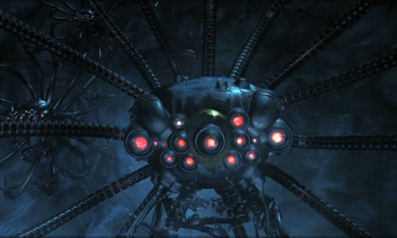
First, we'll note the movie's derivative nature. The Mimics, violently flailing tentacle-beasts that look like mechanized versions of the Flying Spaghetti Monster (sex among Mimics must be exciting and raunchy), remind me of nothing so much as the Squiddies from "The Matrix." "Tomorrow" also evokes "Starship Troopers," although it largely lacks Paul Verhoeven's blood-and-gore aesthetic. The time-looping calls to mind the "temporal causality loops" that were such a feature of the "Star Trek" TV series, as well as Bill Murray's "Groundhog Day," which is more of an axiological causality loop (Murray can't leave the loop until he becomes a good person). Then there's the video-game aspect: "Tomorrow" looks and feels a lot like an exhausting bout of Halo: die, then retry, and improve your skills with every go-around as you learn to anticipate the enemy. On top of all this, the movie is itself based on a Japanese novel, with the Japanglish title All You Need is Kill. But this seems to be the way of so much American science fiction: it's all derivative these days.
Other aspects of the movie are generally up to snuff. The special effects in "Tomorrow" are impressive, although the video-game nature of the action does drain some scenes of emotional impact. The acting, even from Bill Paxton as Master Sergeant Farrell Bartolome, is good and believable. At first, I was convinced the soundtrack was yet another cookie-cutter Hans Zimmer affair, but the composer, it turns out, is Canadian Christophe Beck, about whom I know nothing.* Beck does a convincing Zimmer impression for most of the film.
The story is also surprisingly simple, despite all those time-loop epicycles in the plot. Essentially, the plot is like that of a video game: there's a hierarchy of aliens, and the heroes have to find the "boss" alien and kill it. I don't know why so many book and movie aliens are hive-minds with a "queen" that, once killed, renders all the drones useless (cf. Ender's Game), but that's the scenario we're given in "Tomorrow."
As with the recently reviewed "X-Men: Days of Future Past," "Tomorrow" has some metaphysical problems. Here's one: what happens to a timeline when Cage dies? Does it continue on without him? One scene in "Tomorrow" makes me think the answer might be yes: in this scene, Cage has already died and respawned several times, and he's trying to get away from his platoon, which is in the midst of doing pushups as punishment. Cage executes a roll away from the platoon, hoping to time his roll so that he travels under a passing truck and out the other side. He mistimes the roll, and the truck crushes him to death (we hear the sickening crunch of bone). Sergeant Bartolome then turns around and sees Cage's corpse (still off-camera), exclaiming, "What were you thinking?" Question: why would Bartolome still be around long enough to exclaim that? The implication is that that timeline continued without Cage, which makes it fair to ask whether Cage's other deaths have resulted in other alternative timelines, each as fully existent as the original one. Is this a frothing multiverse? If so, I've discussed such metaphysics before elsewhere. I often think that Hollywood scriptwriters don't think much further than the ends of their noses when it comes to dealing with time paradoxes and other weird ontological phenomena.
All those complaints aside, I enjoyed "Edge of Tomorrow" for what it was: good, mindless entertainment that, like "X-Men," delivered on the action, even if it was a bit short in the brains department. Tom Cruise, warrior for Scientology, once again does his own stunts, and given the knocking-about he receives, I'd say he gave this one his all. Emily Blunt was surprisingly convincing as an action heroine; given her delicate presence and her ubiquity in romantic comedies, she wouldn't have been my first choice as the inheritor of the Sigourney Weaver/Linda Hamilton mantle. Still, she did yeoman's work in this film, so hats off to her. "Edge of Tomorrow" contains plenty of action, plenty of spectacle, and just a tantalizing hint of some Big Ideas. The plot, despite involving so many causality loops, isn't particularly complex, and the time will pass quickly.
*A Wikipedia search reveals that Beck scored "Bring It On" and "We Are Marshall," as well as several seasons of "Buffy the Vampire Slayer."
_
Sunday, June 08, 2014
watch this space
I'm about to see Tom Cruise's "Groundhog Day" remake, "Edge of Tomorrow." Stay tuned for a review.
_
Saturday, June 07, 2014
pasta redux
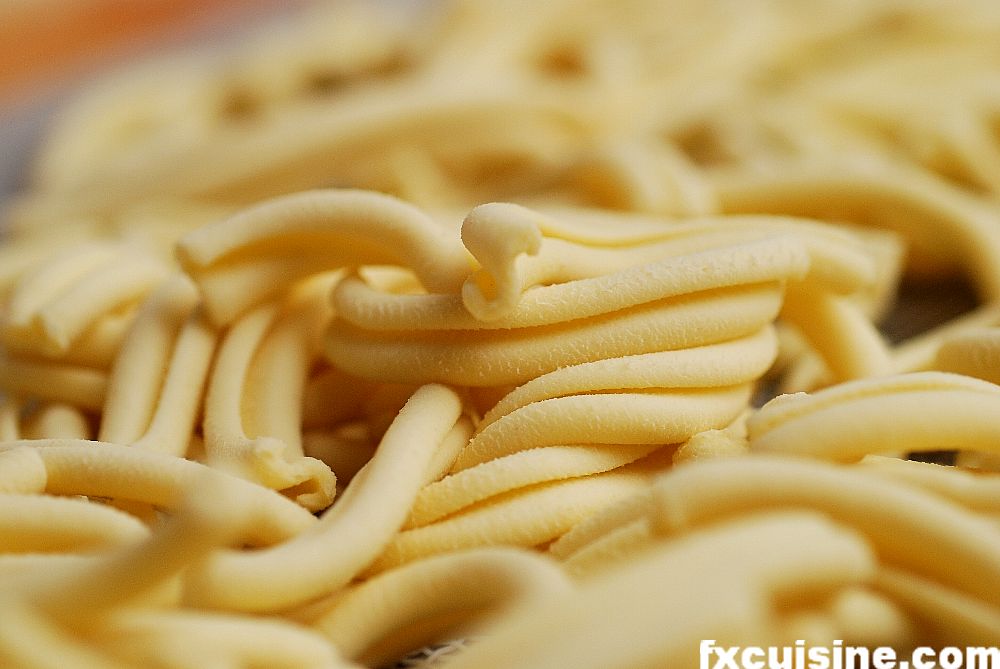
Since I've been using up my recently purchased Costco supplies, I thought I'd slap up a pic of a second quasi-Alfredo, which came out better than the first:
My method for producing the crispy bacon that you see in the above photo is a bit unorthodox. The secret is to avoid letting liquid build up while the bacon is cooking. I use my meat shears to scissor the bacon into small chunks, then drop the bacon pieces into a non-stick pot (yes: pot, not pan—the high walls of the pot do wonders to minimize grease spatter). I start with the gas range's temperature on maximum, letting the bacon cook down for about five minutes, stirring occasionally and separating any slices that are sticking to each other. Fat and water are cooking out of the bacon during this period, so at around the five-minute mark, I reduce the heat to medium and start scooping out the liquid with a ladle. I can't grab everything, but what I grab is enough to expose the frying bacon directly to the pot's interior surface. As time goes on, the liquid becomes almost all fat, and I again scoop it out every few minutes. Stir, scoop, separate; repeat as needed. This continues until the bacon is thoroughly crisped, at which point I use tongs to remove the meat, then pour the rest of the grease into the collection bowl (civilized people never pour bacon fat, or any fat, directly down the kitchen sink's drain). Voilà—crispy bacon, ready for just about any use, from breakfast to salad garnish. In this case, I tossed half the bacon into the quasi-Alfredo and stirred it in; the rest of the bacon was sprinkled on top to preserve some crispiness.
Just about every Alfredo recipe I've ever encountered lists a particular Holy Trinity for the sauce: butter, heavy cream, and cheese. A standard Alfredo uses Parmigiano Reggiano, but this time around, I used Gorgonzola (which, to be honest, I find indistinguishable from bleu and Roquefort). Because these ingredients, once melded together, are fairly bland, the aforementioned recipes normally suggest adding herbs and seasoning. For me, that means powdered garlic and dried parsley—just a soupçon of each. The result smells and tastes magnificent, as was true when I made the above dish yesterday.
Wegmans sells a beautiful triple-crème Brie that my buddy Mike got me hooked on. It's not cheap, so I wouldn't be able to buy it routinely, but I do wonder what it would be like to use that cheese in my quasi-Alfredo. I suspect the result would be positively sexual. I didn't see that sort of Brie being sold at Costco, however, so the Brie issue is moot. For now.
_
Friday, June 06, 2014
my lovely student
My student had no idea what the word on her hoodie meant. I told her that I had to snap a pic of her, shirt and all, and upload it to my blog. I think she was secretly titillated by the attention I was paying her.
So, yeah: it says
Put wings on your dream.
Go figure.
In fairness, I should note that there's a popular blog devoted to Western misuse of Chinese characters. It's called Hanzi Smatter. See here.
_
Thursday, June 05, 2014
choose life
My brother David just sent me the following adorable link:
Pool Repairman Saves Squirrel with CPR
I suppose the Huffington Post is good for something. Thanks, Arianna.
_
and then there were 15
Thanks to a retweet by KimcheeGI, I see that the number of missing from the Sewol disaster has gone down to fifteen: the latest body was found miles from the ferry itself. Salvage crews suspect that several bodies are still trapped inside the sunken vessel, but they'll have to cut out a wall or two and move aside a load of cargo before they can be sure.
_
ups and downs
This past Tuesday was the final session for my Veteran Beginners Korean class. The students—five of whom showed up out of the original seven—had apparently gotten together and bought me a gift: a very nice ornamental folding partition covered in lovely calligraphy on one side and reproductions of Korean landscape and folk-life scenes on the other. This was thoughtful: I had once expressed my love for brush calligraphy in class, and the students obviously remembered that. They also gave me a signed card on which each student had written a short message in Korean. I was touched. One student came up to me after class and privately gave me yet another gift: W30,000 worth of Lotte gift certificates, which she said I could use whenever I wanted to go see a movie. Wunderbar! I'll miss this group. The Veteran Beginners had a 71.4% retention rate (in terms of their attendance); my Absolute Beginners, alas, had only a 33% retention rate (out of six students at the beginning, the class dwindled to two). Still, I was happy to teach both classes, and I hope my students will continue to pursue, and eventually master, Korean. They've done me proud.
On the not-so-bright side, today's Thursday-afternoon beginner-level English classes were a pain to teach, especially the 3PM class. I don't know what it is, but both of these classes are filled with slackers and students too goofy to remember to bring along even the most rudimentary of materials for class: I've got students (not just in my Thursday classes, truth be told, but also in my Monday classes!) who neglect to bring paper and a writing implement. Several students routinely forget their textbooks. I chewed out one Monday girl, who's cruising for an "F," for not caring about the class, for constantly talking* in class, and for never bringing her textbook. "But I brought it today," she said lamely. On the day she said that, we were doing presentations, so there was no need for a textbook. I shook my head in sincere wonder at her empty-headedness. I used to think that Korean college kids had the social and sexual maturity of a typical American high schooler; these days, I wonder how many of my kids have progressed beyond elementary school, so lacking are they in basic common sense. This is what comes of a culture in which children are spoon-fed everything: there's no motivation to actually learn anything—let alone to learn how to think.
On top of all that, there's the sheer childishness of some of these kids. They're not shy about moaning and groaning aloud when they're told they need to do just one more exercise, and they visibly drag their feet whenever they have to perform any sort of task that involves getting up and moving about the classroom. Some kids, maybe one or two, attempt to nap in class, but I won't let them. But it's the talking while I'm talking that bothers me the most; many students are damn rude and need to learn some manners. They also need to grow up.
Be that as it may, the semester is coming to a close, and my eyes are set on the far horizon. Not all my kids are bad; I don't mean to give that impression. But there are enough who are so goofy and unmotivated that I sometimes question the utility of what I do. I'm not sure how many of these students will, years later, have gained the wisdom to understand their current unwisdom. Maybe some will. Most won't. And that's too bad.
Life is full of ups and downs. Sometimes you get well-motivated adult students, fellow professionals who appreciate your efforts; sometimes you get equally motivated undergrads who are sharp and driven; sometimes, well... sometimes the munitions factory churns out duds. Not enough duds to make you lose all hope, but certainly enough to notice.
*Obviously, you're supposed to talk in an English class. But you're not supposed to talk in Korean; you're not supposed to talk while the teacher is talking; you're not supposed to talk off-task.
_
Wednesday, June 04, 2014
"24: Live Another Day": review
I've been following Kiefer Sutherland's return to "24" in "24: Live Another Day" (24LAD), which plunges us once again into the turbulent life of Jack Bauer, the world's angriest counterterrorism agent. Along with "Battlestar Galactica," "24" was one of my favorite TV series, despite its cartoonish implausibilities. When it was over, I felt lost. Now it's back, but only for a special "event run" of only twelve episodes.* At this point, we're up to episode 6, so the story is halfway to its conclusion.
24LAD picks up four years after the end of Season 8. That season ended with Jack Bauer on the run from both the US and Russian governments: he had killed a number of important Russian officials, and had even prepped to assassinate the Russian president. The new story, thus far at least, takes place primarily in and around London, England. Jack surfaces in London and gets caught by the local branch of the CIA (apparently, the CIA operates with near-impunity in England—what gracious hosts, the English!); Chief of Station Steve Navarro (Benjamin Bratt, no longer in romantic-comedy mode) gets nothing out of Jack, but Agent Kate Morgan (Yvonne Strahovski) figures out that Jack has allowed himself to get caught. His reason: to break out his old, faithful friend, Chloe O'Brian (Mary Lynn Rajskub), who has gone from being a loyal counterterrorism apparatchik to being a rogue, Snowden-style disseminator of classified information.
Chloe is Jack's crutch: Jack needs her to help him foil an attempt on the life of US President James Heller (the awesome William Devane, who starred as SecDef Heller in Seasons 4 through 6): someone has figured out a way to commandeer the US drones flying in UK airspace; this someone plans to target Heller and/or UK citizens while the president is in England. Heller, for his part, is showing his age: the show hints that he has a steadily advancing case of Alzheimer's, which makes his aides second-guess his judgments. Heller's Chief of Staff, Mark Boudreau, hates Jack Bauer and quietly undermines Heller's efforts at constructive relationship-building with the English. Boudreau is married to Jack's old flame Audrey, whom he has patiently nursed out of the Jack-inspired catatonia she had been in since Season 6, thus explaining his animus toward Jack.
"24" has always done an excellent job of giving us multilayered characters driven by complex motives. Chloe is torn between her new loyalty to Open Cell, the rogue hacker group of which she is a member, and to Jack who, despite being her best friend, represents the government she now stands against. Mark Boudreau initially comes off as a sneaky bastard who will do whatever it takes to hand Jack Bauer over to the Russians, but once he meets Bauer, he immediately regrets his chicanery. Boudreau may be this series's Lando Calrissian: it's not obvious which way he'll break when the going gets tough. President Heller has a checkered history with Jack, who once threatened Heller at gunpoint at the end of Season 6. Heller is protective of his daughter Audrey; he sees Jack as having an aura of death around him, and he wants desperately to keep his daughter out of Jack's ambit. At the same time, Heller is a former fighting man, and he sympathizes with Jack's predicament.
Despite its obvious, Dan Brown-style narrative formula, the plot of "24" is often devilishly hard to predict. I had thought that Margot Al-Harazi (Michelle Fairley), the embittered widow who has taken over six US drones, would end up killing her daughter Simone (Emily Berrington), but instead Margot killed her daughter's husband, and Simone has been hit by a bus. I keep expecting Chloe O'Brian to die this season, but I have no idea whether that will actually happen. In Episode 6, we find out who the mole is in the CIA's London station, and it's not who I thought it would be. Busy, busy, busy, says Bokonon. If "24" teaches us one lesson, it's that the best-laid plans can go very much awry; Murphy's Law is a cosmic principle.
One flaw of "24" has been the general weakness of its female characters, with Chloe O'Brian being the major exception. Jack's love interest in Seasons 7 and 8, the stunningly sexy redhead Renee Walker (Annie Wersching), was simultaneously very strong and very needy—not a stand-alone feminist type. Katee Sackhoff's Dana Walsh proved to be a liar and a murderer—not exactly feminist material. This time around, however, Agent Kate Morgan might finally be a match for Chloe: she's brainy and perceptive, she's good with a gun, and as we saw—painfully—in Episode 6, she can withstand massive amounts of torture and still manage to engage in a firefight. Her one foible is that she was apparently unable to see that her husband had betrayed the United States by selling secrets to a foreign power, but events in Episode 6 now call that into question: her husband might not be the traitor he's been made out to be.
Oh, yeah: torture. Torture's back, so let's talk about it. Torture is a "24" tradition, after all, and this time we see a form of torture not seen in previous seasons: the strappado. This ancient method of pain-infliction involves tying the victim's hands behind his or her back, connecting a rope or chain to the victim's bound wrists, then hoisting the victim into the air via a pulley. This puts a horrible strain on the victim's shoulders, which often break under the pressure of gravity. Poor Kate Morgan gets the strappado treatment, and the filmmakers aren't shy about showing her hanging there, screaming. I admit I felt very squeamish watching this—perhaps more squeamish than I'd ever felt watching any previous scenes of torture on "24." At the same time, I marveled that Kate's shoulders didn't pop, and that she was able to use a gun not long after her release from the strappado. That blow to my suspension of disbelief made up for any previous squeamishness.
All of which is to say that "24" is back, thank God, and it's brought along its old bag of tricks. It's too bad that there are only six more episodes to go. Some people might complain that the series isn't breaking any new narrative ground, but this is one case in which familiarity does not breed contempt. If the old formula ain't broke, don't fix it. Despite the familiarity, though, there's a new set of players: for example, there's Stephen Fry, fresh from playing the Master of Lake-town in "The Hobbit: The Desolation of Smaug," as British Prime Minister Alistair Davies. There's also gravel-voiced Michael Wincott as Adrian Cross, charismatic leader of Open Cell (you may remember a much younger Wincott as Guy of Gisborne in the Kevin Costner version of "Robin Hood"). Some interesting people have come to this party, and they liven up "24" as the plot hurtles forward. I'll be curious to see how matters resolve themselves.
*As before, the show still runs in real time, but hours will occasionally be skipped.
_
closing the books on the missing 16
I had been stopping by the Korea Times website about every other day to watch the rather morbid body-count ticker that had been placed at the top of the website's splash page. The number of missing people slowly dwindled to sixteen; it held there for days and days... and then the ticker was taken down without any further updates or explanations.
So—what did I miss? Have the missing been declared dead? I mean, I don't expect that any of the missing will turn up alive at this point, but I'm just wondering whether the Korean government has made an official decision to call off the search for the last cluster of bodies.
The whole thing has been one sad, sordid affair. The Sewol ferry disaster ripped open Korean society and caused a great deal of agonized soul-searching among Koreans—many of whom, it should be noted, did and do buy into the "culturalist" explanation of the disaster's causes, even while Western apologists (including yours truly) have argued against a facile oversimplification of the issues. I hope that some good has come of all this, especially in terms of Korea's cavalier attitude toward personal safety vis-à-vis the almighty won. I hope there's now a greater awareness of the culture of cronyism and corruption that can lead to such tragedies, and that Koreans, if they truly care about the world's opinion of their country, will listen to critiques from expats and other non-Koreans without dismissing them offhand as the resentful or unenlightened grumblings of the ignorant. I hope the world at large has learned a lesson or two from the Sewol disaster, especially regarding the preciousness of human life.
Of course, it's likely that nothing has been learned. Korea, in the midst of its pain, recited in its newspapers the long litany of preventable disasters that the country has experienced over the years, sadly noting that, from disaster to disaster, nothing seems to change. We can only hope that the loss of nearly 300 high schoolers will have taught the country to break its cycle of greed, passivity, and recklessness, but this is admittedly a feeble hope.
Today is Election Day, and it's very likely that President Park's political party, the conservative Saenuri, is going to suffer losses in many local elections as angry citizens use their votes to punish her administration for its perceived incompetence in the face of the Sewol tragedy. This anger is misplaced, in my opinion, but it's also not surprising. Tomorrow, we'll find out how radically the political landscape has changed.
_
Tuesday, June 03, 2014
campus burger
There's a cafe on campus called Windy City; I've been there once or twice before, and I went back again today. This time, the purpose was to try the burger set (Koreans use "set" instead of "value meal" to describe prix-fixe menus). It turned out to be modestly sized, which was no big surprise, but the burger itself had that soft, homemade feel about it. The real revelation, though, was the dipping sauce that accompanied the French fries: from a distance, the sauce looked like ketchup, but it turned out to be sweet-and-spicy chili sauce. I could have used more of that, along with about three times as many fries.
Click on the image below to enlarge:
It wasn't a bad burger, overall; I might go back and order it again. I liked the vegetables, and the egg atop the burger patty was cute (see it hiding in there?). I could have done without the weird sauces on the burger; ketchup and mayo would have been fine. I had also tried to order a chicken salad, but the guy at the counter told me, "No salad," so that's a strike against Windy City—not enough to make me forsake the place, but enough to make me cautious. This is the second time that the restaurant has run out of something. Not a good sign.
Righto—I'll be teaching my final Korean class this evening. Just two more hours to go until class. I'm sad that I won't be seeing this group any longer, but at the same time, I wouldn't be human if I didn't admit to a feeling of relief about having my evenings free again for the first time in months (my students doubtless feel the same way!). The semester is drawing to a close; I'm no longer teaching classes, per se; I'm now engaging in review and prepping my students for their last two big exams: a school-sanctioned listening test and the six classes' respective final exams. After that, it's just a matter of finalizing grades.
As the gyopos like to say: Laters.
_
Logan's mind: redux
If you read my recent review of "X-Men: Days of Future Past," you know I had some issues with the movie's physics and metaphysics, especially with regard to Kitty Pryde's ability to project another person's consciousness back in time such that the present consciousness can inhabit that person's past-era body. As I noted, this creates the problem of what happens to the person's past-era consciousness: either it gets kicked out, in which case I have no idea where it goes; or it remains in the brain and gets temporarily(?) "overwritten" by the invading consciousness being pumped backward from the future, reasserting itself only after the future consciousness departs.
So what happens to Logan's mind(s) when Kitty Pryde sends him back to 1973 from the 2020s? And what about that question I had asked before: "What would happen if Kitty Pryde were to disappear? Would the future Logan's mind be forever stuck in his 1973 body?"
Second question first. I think I know the answer to this one: Kitty Pryde had to remain in constant contact with the 2020s-era Logan's body in order for Logan's mind to remain in the past. This implies that it was an effort to keep Logan's mind in the past; if Pryde's strength were to flag, Logan's mind would snap back to the 2020s. Why? Because in projecting Logan backward to 1973, Kitty Pryde was fighting the flow of time itself. Time naturally flows forward, so sending Logan to the Seventies was like struggling upstream in a river with a strong current. The current would never let up, so neither could Pryde. If Pryde ever did let up, Logan's mind would snap back into the future/present... but if Pryde has disappeared because the original future timeline has been erased, then where would Logan's mind snap back to? Would it automatically track down and inhabit alternate-Logan's mind, seeking Logan out like a guided missile? If alternate-Logan's current self already had a mind, having arisen from a completely different set of events, would alternate-Logan's consciousness again be kicked out (not in 1973 this time, mind you, but in the 2020s) in favor of original-Logan's? As we can see, the original question is answerable in the negative, given the strength of time's relentless flow, but other questions immediately arise as to where, exactly, Logan's mind would go.
As for the first question—what happens to Logan's mind(s) when he's sent backward?—there seem to be only two alternatives, already mentioned: (1) the past mind is ejected and goes God-knows-where, or (2) the past mind remains in Logan's 1973-era skull, but is "overwritten" by the 2020s mind, which is at best a temporary guest held in place by Kitty Pryde and her retro-temporal energy. Personally, I favor (2), as it seems to offer fewer loose ends. With (1), the problem is that we are again presented with multiple, messy alternatives:
(a) the 1973 mind simply goes nowhere—poof. Once ejected, it's gone, which means that once Logan's 2020s consciousness departs, there will be nothing left to inhabit Logan's 1973 body (at this point, I think we can assume that substance dualism is true in the Marvel universe; how else to separate a mind from a body?). A mindless Logan trapped in 1973 would further alter the past, thus further altering the future in very undesirable ways (assuming Logan's continued existence is a boon for the world).
Or (b) Logan's mind must go into some sort of metaphysical holding area, which takes us to the liminal space where science fuzzes into religion. In the Star Trek universe, certain types of consciousness can be physically contained, as happened on the planet Vulcan which, in JJ Abrams's 2009 "Star Trek," featured a very brief scene of a "katric ark" that allowed normal, enfleshed Vulcans access to the disembodied minds of the ancients and not-so-ancients.* Could such a hold exist in the Marvel universe, and would it serve as a temporary consciousness-container—a mind motel, if you will—for Logan's ejected consciousness? Or would the holding area be more like some "folded" region of space—less a brute physical container and more a subtle metaphysical one? Either way, the fact that we have to posit such a space in the first place indicates how unwieldy alternative (b) is.
All of this brings us back to what I'd said in my earlier movie review: it doesn't make sense. If you think too hard about the metaphysics of the X-Men universe, you'll just end up blowing a gasket. Better just to sit back, enjoy the movie, and not think.
*If I'm not mistaken, older Trek lore would style this the "Hall of Ancient Thought." Somewhat misleading, as recently deceased minds deemed great by Vulcan standards could also be ensconced there. In older Trek lore, each Vulcan soul, or katra, was placed inside its own katric ark, but the term as used by JJ Abrams refers to the entire structure carved into Mount Seleya, making it the equivalent of the Hall of Ancient Thought.
_
Monday, June 02, 2014
peace be upon Costco
Without Costco, my dinner would not have been possible:
The pasta—and this may be a bit gross—actually comes from an old bag that had sat for years in Sperwer's basement. Most of my possessions had gotten moldy, but the pasta looked perfectly serviceable, and I knew that boiling it for ten or fifteen minutes would thoroughly sterilize it.
Ingredients for tonight's splurge:
Garofalo brand casarecce pasta (essentially free since it was a found item)
Président brand crème supérieure (whipping cream): W13,990
Bel Gioioso brand crumbled Gorgonzola (bucket): W13,490
Kirkland brand butter (16 4-ounce sticks): W19,990
Kirkland thick-cut bacon (4 1-pound packs): W18,390
There was a W2,700 discount thrown in for some reason, so my total was W63,160, or about $61.88 at the current exchange rate (about 1020 won to the US dollar).
As I've often said, Alfredo sauce (or quasi-Alfredo, in this case) is rather simple to make. The most labor-intensive aspect of tonight's repast was cooking the bacon until crisp, and that was more time-consuming than anything. Otherwise, just cook the pasta, drain it, then throw in equal measures (by volume) of butter, cream, and cheese. Add a bit of powdered garlic and parsley. Add bacon. Stir until a sauce forms; that's the traditional Italian way to arrive at a sauce: generally speaking, you conjure it, i.e., you don't make it on the side and then pour it over the pasta; the pasta is supposed to be in dialogue with the sauce from the sauce's inception,* and the sauce simply appears as you keep on stirring. Like sorcery.
I must say... I like my version of cream pasta a lot better than my school's version. My version is way more rib-sticking and flavorful. I might serve this at the jjong-party I'm planning to have with my lone intermediate class, but knowing Koreans as I do, I know I'll have to serve something salty and pickled alongside it—probably oi-kimchi (cucumber kimchi), in this case, because that's the only kimchi I know how to make well. Koreans feel that creamy and/or greasy food should be balanced out with something that counteracts the oil; this is why "Italian" restaurants in Korea serve pickles with their pasta and pizza.
*Unless we're talking about a sauce like bolognese. That sauce would take too long to come together if it were mixed with pasta from the beginning. The spaghetti would be mush by the time the sauce was ready to serve.
_
Sunday, June 01, 2014
Costco adventure
Naver had better not be fucking with me. It's done me wrong in the past.
Naver, for those who don't know, is a popular Korean portal site where Koreans go to find out... well, just about everything. It's got a Google Maps-style map function, news, dictionaries, and links to all sorts of new and interesting things. I often use Naver to find out local movie times, and on days like today, I use it to try to navigate to places I've never been.
In this case, that place is Costco, and I didn't see a Costco that was easy to get to. The nearest branches of the warehouse giant seem to be in Daegu proper, so I selected one branch and clicked on the route-finder function to figure out how to get there. Sadly, the route requires two transfers, which is always a pain in the ass: take a local bus to Anshim Station, take the subway to Ayang School (Bridge?) Station, then take another bus the rest of the way to Costco. Naver estimates travel time at nearly 80 minutes, which means I won't be hitting Costco for fresh meat or seafood: with travel time taking that long, and with late spring in Daegu reaching temperatures of close to 100ºF, any meat would spoil en chemin. Better just to stick with the local E-Mart. That said, there are things I can buy at and tote from Costco, like American-style bacon and cheese; these products would survive an 80-minute trip home.
So I'm off, in a few minutes, to find this legendary store and to obtain a Costco membership (yes, KMA paid me). If any fellow profs are reading this and know of a Costco that's closer and more convenient to get to, let me know in the comments section.
UPDATE: Success! Costco proved to right where Naver said it was: take any local bus to Anshim Station, take the subway to Ayang-gyo Station, exit out of Exit Number 1, then take the 323-1 bus right up to Costco's foyer. Getting my membership was easy, and it cost me only W35,000 (a little over $30, US, as opposed to the US cost of around $55 for the Gold Star membership). Alas, Korean Costcos don't sell some of the things I need, like armpit deodorant. Still, they've got a wide assortment of familiar, comforting, fabulously unhealthful American products, so I bought myself two huge briques of heavy cream, a tub of crumbled Gorgonzola, and a huge multi-pack of Kirkland bacon. I was delighted to see that Daegu's Costco sells Kirkland dinner franks as well as other US hot dogs, so I'll be going back for those sometime later. A good hunt today; the gods are pleased.
_